


 Read the peer reviews for this feature.
Download the graphs for this feature.
Today’s railway makes much of the lower costs that electric trains bring. They cost less to buy and less to maintain than diesel trains. They do come with a capital cost incurred to erect overhead wires and associated power equipment, but they generate lower track costs and lower fuel costs (see table).
All good reasons to switch… but there’s another, more important, reason. Attributed to John Aspinall, general manager of the Lancashire and Yorkshire Railway from 1899, are these words: “Electrification is carried out not to save money, but to make more.”
His words hint at what was later described as the ‘Sparks Effect’ - the increase in passengers that followed successful electrification schemes. BR London Midland Region General Manager Henry Johnson reported in 1968 that traffic rose 59% on London-Manchester and 60% on London-Liverpool services in the first four weeks after they converted to electric trains. Receipts rose 53% and 47% respectively. Over the first year both routes experienced increases in passengers of around 55% and increases in receipts of around 39%.
Yet it was Johnson who had suspended West Coast Main Line electrification when he was appointed to the top LMR job in 1962. What today might be called a ‘pause’ took place, to allow a project review to check whether it was justified. The review cost the project a year and led to some quieter lines being dropped.
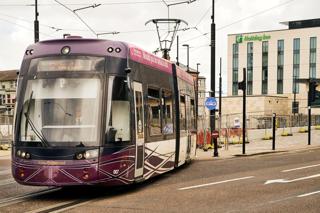
For his part, Aspinall electrified two routes: Liverpool-Southport/Crossens/Ormskirk and Manchester-Bury-Holcombe Brook. While Holcombe Brook closed in 1960 having lost its electrification in 1951, today Manchester Metrolink runs electric trams to Bury while Merseyrail runs EMUs to Southport and Ormskirk (Crossens closed in 1964).
They could be described as the exceptions to a rule that electrification is often talked about but rarely implemented. Consider that the North Eastern Railway had plans in 1919 to wire York-Newcastle. The Great Western Railway commissioned a scheme in 1927 to electrify Taunton to Penzance. Bringing electric trains to the Great Northern suburban network from King’s Cross was considered as far back as 1903, but it was 1976 before passengers were carried on electric trains (the same Class 313s in which they travel today).
Despite offering good returns - a 1981 report by the Department of Transport and the British Railways Board reckoned 11% - the history of electrification contains more cancellations than openings. As former Network Rail electrification expert Peter Dearman told an Institution of Mechanical Engineers (IMechE) conference in June 2015: “When the cost goes up or the economy goes down, enthusiasm wanes.”
And costs have certainly gone up. Network Rail’s Great Western scheme has risen from £1.6 billion in 2014 to £2.8bn in 2015. When it was first announced in 2009, the Department for Transport had put the cost at £1.1bn, including a separate Liverpool-Manchester scheme.
Secretary of State for Transport at the time was Andrew Adonis, who said: “Over the medium term this £1.1bn investment in electrification will be self-financing, paying for itself through lower train maintenance, leasing and operating costs. This means that this investment can take place without reducing already planned infrastructure enhancement work.”
In its 2009 electrification strategy, NR said: “Two schemes - the Great Western Main Line and the Midland Main Line - have particularly high BCRs without dependency on further electrification. In the case of Midland Main Line the value is technically infinite given that it involves a net industry cost saving rather than a cost.
“The Great Western Main Line BCR lies in the range from ‘high value for money’ to ‘financially positive’ over the appraisal period, depending upon IEP cost assumptions. There is an upfront investment requirement for Network Rail which is potentially offset by lifetime cost savings, largely in the costs of train operation.”
Tripling the bill hugely extends the payback period. When consultant Merz and McLennan analysed a London-Doncaster-Leeds/Lincolnshire lines scheme for 1931’s Weir Report, it found a return of 7.2% on a capital outlay of £8.6 million. Tripling that outlay cost cuts the return on capital to 2.4%.
Yet NR’s 2009 strategy makes little reference to infrastructure costs as a driver of BCRs, and instead concentrates on how rolling stock costs might change. Taking an optimistic tone, it suggests: “Network Rail, working with its supply chain, would develop efficient delivery mechanisms to ensure the work would be undertaken at low benchmarked unit costs with minimal disruption to users.”
It’s not hard to imagine that had the DfT not already signed an expensive contract for electric trains, the whole GW project would have been cancelled. That today’s politicians continue to support rail’s plans would surely amaze their predecessors. It should shame railwaymen, because they don’t deserve that support having presided over such an increase in costs.
In the 1980s, British Rail faced a battle to persuade government to authorise East Coast Main Line electrification to Leeds and Edinburgh. This was estimated at £212m in 1982, authorised at £306m in 1983, and completed for £319m (1983 prices, £911m in 2012 prices to give a comparison with GW).
While arguing for ECML wires, BR closed its electric route across the Pennines, amid falling coal traffic but barely 25 years after running the first electric train on the Manchester-Sheffield-Wath route. In British Rail 1974-97, railway economist Terry Gourvish suggests that this closure did not help BR’s case, but Eastern Region General Manager Frank Paterson (responsible for the line at its closure in 1981) has said he was convinced that the closure influenced government to approve the ECML wires.
BR tightly controlled ECML wiring costs. It has become fashionable to criticise the route’s electrification as unreliable, noting the apparent ease with which the wires have fallen and the disruption that results.
Although not citing the ECML scheme explicitly, NR said in January 2013 in A Better Railway for a Better Britain: “In the past corners were cut when electrifying lines. Ultimately passengers are paying the price for that decision, with disruption today. The cost of replacing this sub-standard equipment is far higher than if the job had been done properly the first time.”
Yet it’s difficult to see Margaret Thatcher’s government authorising the ECML scheme if the initial estimate of £212m had tripled to around £650m, as NR’s GW plan has.
The ECML scheme stretched the distance between masts to the limit, so needed fewer masts. It also used wire headspans over sections with more than two tracks. This also reduced the number of masts and foundations and does not need steel girders spanning tracks, lowering costs (although the masts were taller). German railways make extensive use of headspans. ECML reliability has improved since maintenance was increased.
The response to criticism of the light and cheaper electrification of the East Coast has been to design a new overhead line equipment (OLE) system that is much more substantial and much more expensive. Hence Peter Dearman’s comment to 2015’s IMechE conference: “Any idiot can throw money at a problem.”
Dearman was very critical of the latest OLE designs, claiming that they were over-engineered and too conservative, with components that were too big and too expensive. “If we ignore this, we’ll have another electrification plan that’s failed,” he argued.
Early OLE schemes were heavily engineered. They had to be because Britain had settled on 1,500V DC as its standard. DC systems need hefty cables to cope with the high current they need, and demand frequent sub-stations to cope with voltage drop.
The British Transport Commission’s 1955 report into main line electrification found that a track mile of DC electrification needed 9.0 tons of copper and 24.0 tons of steel, while AC needed 2.9t and 20.0t respectively. It considered London-Manchester/Liverpool, and estimated that the DC system needed 70 sub-stations (and a lineside 33kV cable along half the route to feed them), whereas AC needed just 12.
It was this 1955 report that recommended BR adopt 25kV AC as the new standard. OLE design was then refined through Mk 1, 2 and 3 designs over the following years.
Network Rail’s latest Series 1 and Series 2 designs cope with lines above and below 100mph. It is slowly installing Series 1 OLE along the Great Western Main Line, and installed the first mile of overhead line (albeit just an earth cable, not the more complex catenary and contact wires) on the night of November 12 2015. For context, NR should have completed a 16-mile section by September 1 2015 to allow tests to start with the route’s new trains.
Furrer+Frey designed Series 1 for speeds up to 140mph. It claims the new kit will bring reduced capital and whole-life costs, a longer life, reduced supply chain complexity by using standard parts, and improved electrical connections allowing higher fault currents. It says that existing OLE systems cannot be used because train operators want to run longer trains with up to three pantographs (as 12-car trains on ECML, WCML and Great Eastern Main Lines do already), and that standards are getting tougher so “it needs to deal with everything the world throws at it”.
Back in 2013, NR said that it had rejected using off-the-shelf European designs because they would need to be redesigned for UK use, and because they were not suitable for its high-output installation trains.
Series 1 can use a single mast for each pair of tracks. To this mast is attached a cantilever using a hooked connection that is quick to install. From that cantilever a vertical piece has two insulated arms that hold catenary and contact wires. Longer arms are available where designers decide to install a mast adjacent to each track. These arms have a single insulator in place of the two seen in other designs - this has the advantage of reducing the area of live electrics, by placing that insulator further from the mast. Series 1 can use steel portals for lines with four tracks (or more), with the portal spanning the tracks.
To keep the OLE under tension, Series 1 uses Tensorex C+ reels that Furrer+Frey says are lighter and easier to install, in place of the pulleys and weights of older systems. The reels also allow each wire to be held under tension independently of other wires. That means that if something fails, there’s less chance the wires over other tracks will be affected. Network Rail has installed Series 2 OLE between Liverpool and Manchester. Series 2 is fit for speeds up to 100mph, and uses heavier wires at higher mechanical tensions than Mk 3D OLE. It uses Tensorex reels and aluminium cantilevers (which have 11 components compared with the 32 in a classic cantilever).
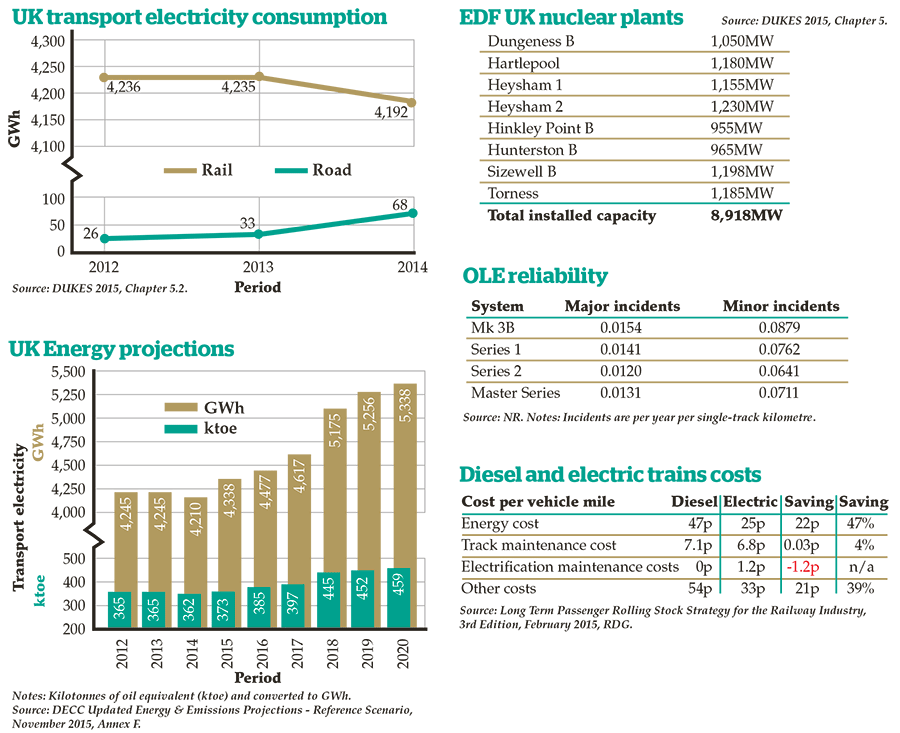
NR plans to incorporate Series 1 and Series 2 into its UK Master Series. It will be divided into Category 1a for lines to 140mph, Cat 1b for 125mph and Cat 2 for 110mph. NR plans to make its Master Series suitable to replace older Mk 1 and Mk 3 installations, and to optimise it for tunnels. The first Master Series installation should be the Midland Main Line (now scheduled to be done by 2023 rather than 2020).
With the increase in overhead wiring planned, and the subsequent increase in electric trains, there will be an increase in electricity consumption. In recent years coal-fired power stations have closed and there have been warnings that Britain’s electricity supply situation is becoming parlous. Despite this, in 2013, then Transport Minister Stephen Hammond dismissed concerns that Britain would not have sufficient power for the Government’s ambition to increase electric trains.
Network Rail consumed 3.2TWh of electricity in 2012/13 and expected this to rise to 4.0TWh in 2019, which was the time government expected it to complete its Control Period 5 electrification programme. As a proportion of total UK consumption, NR used 3% in 2012/13, and expects to consume no more than 4.5% when electrification is complete.
Since Hammond spoke in 2013, Britain’s supply situation has slightly eased. In 2014 regulator OFGEM said that it expected generating margins to fall to their lowest level in 2015/16, as supply from conventional sources (such as coal) reduced. In 2015, OFGEM reported a reduced risk for 2015/16, following mitigation efforts from National Grid, and said it expected further reductions in 2017/18 as more capacity came on stream.
OFGEM futher noted that the average cold spell (ACS) peak demand was falling. It was 60GW in 2005/06, 54GW in 2013/14, and is expected to be 52GW in 2017. It predicted that conventional capacity would rise to roughly 75GW when all installed capacity was included.
Yet in a report released in late January (Engineering the UK Electricity Gap), the IMechE warned of a power gap. It suggested this gap could be around 50%, with the closure of coal power stations and insufficient time to build suitable replacements. It also cast doubt on government proposals to build more gas power stations, noting that it would need a considerable increase in building compared with recent years. This was followed by news of possible further delay in building EDF’s nuclear power station at Hinkley Point C.
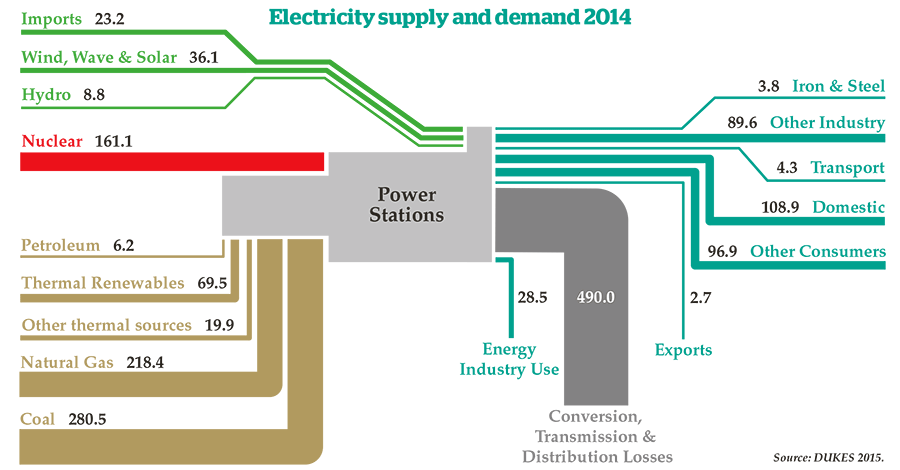
The Government’s Digest of United Kingdom Energy Statistics 2015 (DUKES 2015) reports falling consumption from transport. Currently, 96% of UK electricity consumption for transport comes from rail, with NR and London Underground the major users). But in recent years consumption has been falling (see table), to give a 2014 figure of 4.2TWh. Predictions from the Department of Energy and Climate Change (DECC) suggest that by 2019, transport electricity consumption will reach 5.1TWh. (For context, in 2014 domestic consumers used 109TWh while 490TWh was wasted in conversion, transmission and distribution losses, according to DUKES - see diagram.)
In early 2013, NR announced that it had signed a ten-year deal with EDF Energy for electricity, to be supplied by EDF’s eight nuclear power stations. This, said NR, assured its supply of low-carbon electricity. Overall in 2014, nuclear power stations contributed 161.1TWh, with EDF’s eight stations bringing a total capacity of 8.9GW (see table below).
NR’s 2012/13 figure of 3.2TWh represents 76% of that year’s 4.2TWh rail consumption. Its 2019 (post-electrification) figure of 4.0TWh represents 78% of DECC’s transport consumption prediction. This suggests that NR’s increased consumption remains roughly in line with government predictions, which themselves are within OFGEM’s assumptions for future capacity.
From this perspective, there is nothing to stop NR forging ahead with electrification. With manufacturers offering trains with better energy efficiency (from such techniques as regenerative braking), there’s every reason to convert from diesel to electric.
The large blot on the landscape is the massive increase in capital costs, which has severely damaged the railway’s credibility, but fortunately ministers are happy to look the other way in the face of rising bills. Perhaps, when we have an electric railway equivalent to Switzerland’s, we’ll thank them.
Read the peer reviews for this feature.
Download the graphs for this feature.
 Peer review: Andrew Boagey
Chairman, Railway Engineers’ Forum
It is strangely reassuring to read Philip Haigh’s review of the ‘on-off’ nature of electrical investments in the past. His detailed article chronicles the difficult decisions to invest in electrification, including during times when the value of clean, modern rolling stock must have presented a very compelling public argument compared with the noise and pollution of steam locomotion.
Pressure in the past to ‘pause’ or ‘unpause’ a project has to be seen in its own historical context, because what makes rail electrification particularly difficult is that it requires predictions in both the transport sector and the energy sector, where short-term arguments often obscure the long-term logic. For example, Network Rail makes a commendable decision to engage in a ten-year deal to buy its electricity from nuclear sources. Meanwhile, diesel prices are at historically low levels on the local forecourt. This is not straightforward decision-making territory.
But surveying the long-term arguments in the energy sector in the 21st century, we have to account for security of supply, as well as the need for a global shift towards sources that are in phase with our obligations to support international carbon reduction targets. Electrification is part of that national strategy to decarbonise transportation, which accounts for 28% of all UK carbon emissions. Long-range electric power remains elusive for road vehicle users (and is unattainable for airlines!), but is efficient, achievable and well-established technology for rail travellers.
The long-term transport policy arguments are also quite diverse. Rail electrification forms part of a procurement strategy that engages international rolling stock suppliers, serving a growing world market for this type of traction. With this competition comes continual improvement and innovation - regenerative braking saves energy and lighter vehicles cause less track damage per passenger mile. Both should find their way into the business case.
Of course, each project still has to be supported by its own evaluation of specific benefits and costs. Philip is right to point out the risk to each project’s credibility as costs escalate. Cost increases offer an opportunity for short-term arguments to win over long-term logic. Teams delivering the UK’s electrification schemes cannot expect the Treasury to keep replacing the fuse wire without wanting to know the source of the short-circuit! It would be good to hear more about the challenges these projects are facing and how they are overcome.
Rail electrification projects are technically complex. And they are not all about electricity - there are miles of civil engineering foundation work, bridges to be replaced, and complex interfaces to signalling that have to be managed. Large-scale electrification affects routes and branches. In the end, it only works once all the train diagrams, from depot to terminus and back, are electrified. This can become a monumental challenge for planners and project managers, especially as possession times vary throughout the network. Economies of scale can quickly evaporate. And designs have to account for future increases in service patterns beyond the length of the current operating franchise.
Development of a Network Rail Master Series for electrification designs surely represents a logical strategic approach, as modern materials and methods can now be brought into each designer’s portfolio.
 Peer review: Peter Dearman
Senior Programme Manager, Engineering, Bechtel
Philip Haigh asks whether the UK will have the grid capacity to power electric traction systems as we expand the electrified network. Furthermore, he ponders whether the emerging cost of electrification will give rise to re-assessment of the return on investment, challenging the commitment even to finish schemes already started, let alone any expansion of that programme.
The article highlights that across the whole history of railways, those who truly understand the operation and engineering of railways would not seek to debate the fact that electric railways are superior. Indeed, I would point out that the benefits of keeping power generation off the moving vehicles has been understood from the very beginning.
Brunel did not have access to electrical systems, so he had to look to a mechanical solution. The atmospheric railway was his. In an alternative history where electric traction was developed 60 years before it actually was, it is interesting to conjecture whether the steam locomotive would ever have been developed. I doubt it.
By common consent then, electric traction, with fixed infrastructure power distribution, is superior to all other forms of railway traction. Train performance is better and more consistent. Maintenance costs for both the trains and the infrastructure is lower. Operational availability of trains is better, thus overall fleet size is smaller. Aspinall and Vincent Raven (CME NER) were the pioneers who sparked (pun intended) electrification in the UK - they built while others talked.
Philip appears to question if it was wise to close Manchester-Sheffield-Wath in the early 1980s, and challenges whether that decision helped or hindered BR’s case for East Coast Main Line electrification. The fact is that MSW followed the path trodden by the earlier electrified main line (Shildon to Newport). Both routes were electrified to facilitate the most efficient and effective haulage of heavy mineral traffic. Both were an outstanding success - increasing tonnage per train, reducing operating costs and delivering unprecedented reliability. But both met their end because the traffic they were built to convey went away.
Any business has to make tough decisions, and closures of these routes are examples of such decisions. So I am firmly in agreement with Frank Paterson - if BR had ignored the logical conclusion that without revenue MSW must close, why would any investor consider placing more capital into BR. Of course MSW had to close - to suggest that it should not just because it was electrified is perplexingly illogical. It had earned a return for 25 years, and it had contributed a huge amount to the development of technology. Its closure was in a way part of its success - without that proper business decision, ECML would not have been authorised in 1984.
ECML has been criticised over some years as a scheme “done on the cheap”. Post privatisation OLE reliability was on a downward trend. BR Mk 3 OLE has had its detractors, with comments about the “inferiority” of aluminium conductors and the vulnerability of headspan structures. A major part of the problem was that an inadequate maintenance regime and failure to programme renewal exposed the railway to performance damage.
Network Rail Route Managing Director Phil Verster, in his time in York, recognised this and relentlessly drove implementation of a better maintenance and renewal programme. As a result, ECML performance is now at high levels.
The history of the suspension of the Euston, Manchester and Liverpool electrification in the early 1960s is only interesting if you are prepared to learn the lessons. So here is my view on what it can teach. Those lessons are that route rationalisation as a pre-cursor to electrification is essential if excessive cost in electrification is to be avoided.
Second, the electrification equipment must be simple and constructible. The failure to route rationalise London Midland before electrification and the BR Mk 1 both contributed to the overspend. By the time BR embarked on the WCML north of Weaver Junction, route rationalisation and resignalling (RR&R) had become the preparatory steps, and BR Mk 3 was developed. That was arguably the dawn of the most successful period of OLE rail electrification in the UK. ECML was the biggest example of the success of this whole system approach.
The industry is now having to re-learn those lessons. The start on GW has satisfied no one, but, the whole industry is beginning to act. My own view is that Series One is an excellent OLE system. However, as it stands, there is scope for value engineering to make it cheaper (I am not embarrassed by that word - cheap does not mean poor quality), and that cost reduction is not only material, it is about construction cost. Series One is therefore now where BR Mk 1 was. Engineers today must react positively as they did in the 1960s, and relentlessly engineer cost out.
The power for electrified lines comes from the grid. Power generation connected to that grid must obviously match the national demand. The UK generation capacity is a complicated picture, but I am more interested in what our industry can do.
Our electric traction systems must become more energy-efficient, and our trains must do the same. We have fallen behind other transport industries, with road and air making high-percentage energy improvement. Other nations’ railways are building more energy-efficient trains, as much as 40% improved. Ours are trending in the wrong direction. The grid will ultimately cope with the railway load, but better energy efficiency must be a goal.
- Peter Dearman works as part of the Network Rail/Bechtel alliance on the Great Western electrification project and has a background in railway traction electrification.





Login to comment
Comments
No comments have been made yet.