


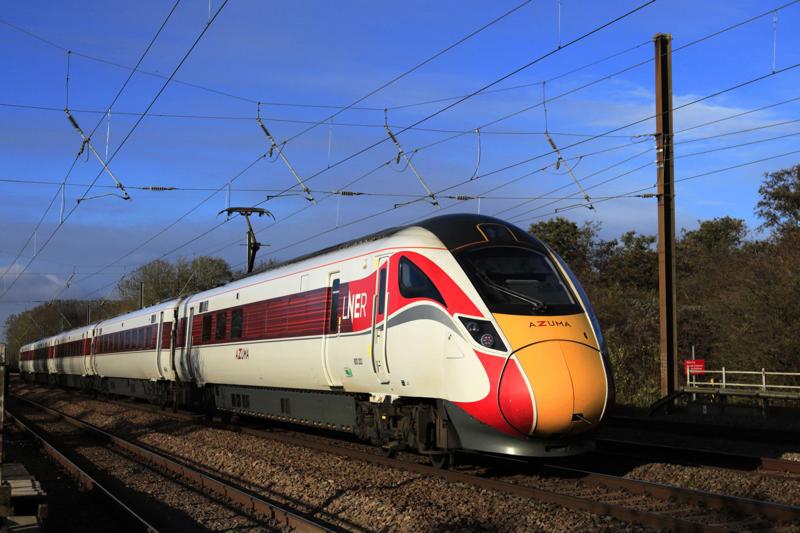
The Rail Accident Investigation Branch (RAIB) has said factors involved in an overspeed at Grantham are probably similar to previous incidents elsewhere on the East Coast Main Line.
The Rail Accident Investigation Branch (RAIB) has said factors involved in an overspeed at Grantham are probably similar to previous incidents elsewhere on the East Coast Main Line.
The 0700 Hull-London King’s Cross LNER service diverged travelled over points into the loop at Grantham South Junction at 55mph on February 25. The permanent speed restriction is 25mph.
RAIB said there was a “strong likelihood” that factors were similar to those identified during investigations into overspeeds further south at Peterborough’s Spital Junction when drivers did not react appropriately to junction indicators.
These involved Lumo and Grand Central services travelling at 76mph and 66mph respectively over a junction where the limit is 30mph reducing to 25mph.
RAIB said some of its recommendations from those investigations remain open, so will not report on this incident as it’s unlikely to recommend anything new.
Two recommendations that were relevant to the Grantham incident (and still being implemented) were to identify junctions where overspeeds could result in derailment, injuries or damage, and to find technical and operational ways to reduce the risk of such incidents.
The branch added: “This incident again illustrates the issues associated with relying completely on train drivers reacting appropriately to a junction or route indicator to control the risks presented by trains taking diverging low-speed turnouts on high-speed through routes. This risk may be increased by the introduction of higher performing train fleets, and possibly by routing patterns on an ever-busier railway.”
LNER said it supported RAIB’s preliminary examination and noted the recommendations.
Login to continue reading
Or register with RAIL to keep up-to-date with the latest news, insight and opinion.




Coling50 - 09/04/2025 17:22
As a retired driver it seems to me that there seems to be numerous drivers out on the ECML who don’t have the correct route knowledge. Whether that’s down to pressure from management to sign a route before they’re fully conversant or is it “new starts” to the railway being let loose on 125mph mainline railway lines without having gained enough experience on slower speed railway infrastructure are question s that need to be answered before there’s a serious “bang” somewhere. That’s three times now in a 2 year or so period that luck has prevented serious injury or death. Luck runs out eventually.